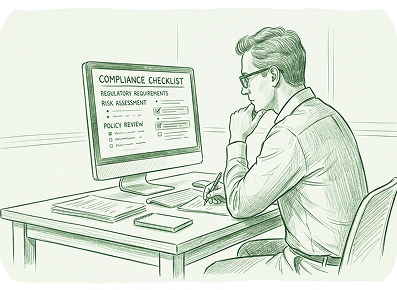
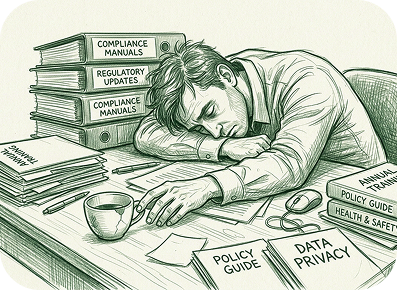
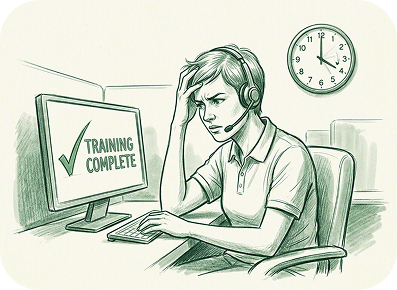
41% of employees say excessive bureaucracy and process overload are major barriers to focusing on their core responsibilities.
What is compliance fatigue?
The stress, burnout and frustration that employees experience due to the overwhelming demands of constantly shifting and complex regulations. Instead of providing a helpful framework, compliance starts to feel like a hurdle stopping employees from doing their jobs effectively. Some companies have even removed the word "compliance" from their training programmes because it has become so divisive.
Where does compliance fatigue show up?
- Healthcare — nurses face burnout related to strict compliance rules such as consistent hand-washing protocols; one study revealed a strong link between nurse burnout and safety regulation burden
- Industrial safety — manufacturing/construction workers struggle with retaining safety training or understanding why certain rules exist, leading to safety protocol violations
- IT and cybersecurity — rigid security measures can feel like a barrier to productivity, leading employees to circumvent them
- Financial services — traders and brokers work under intense pressure while adhering to complicated financial regulations, creating constant anxiety
- Competition law — employees in sales and marketing face scrutiny for anti-competitive practices; many violations are unintentional due to regulatory ambiguity
Root causes of compliance fatigue
- Complex or fast-paced regulatory changes
- Action-based vs outcome-based rules (employees don't see the value in the actions themselves)
- Uncertainty or lack of clarity
- Fear of making mistakes
- High workload and stress
Business impact
Either shortcuts and violations — overwhelmed employees may cut corners to meet deadlines — or reduced performance — employees so focused on compliance they sacrifice other aspects of their work. Both undermine the employee experience and in the worst cases create a culture of anxiety and disengagement.
How to detect compliance fatigue
- Employee feedback through surveys or interviews
- Culture of compliance metrics: adherence rates, number of violations, overall employee morale
10 ways to neutralise compliance fatigue
- Clarify the 'why' — shift focus from actions to outcomes; employees will be more motivated if they understand the purpose behind rules
- Build a culture of accountability — make compliance everyone's responsibility, not just one department
- Bring in external experts — in particularly complex, compliance-heavy industries, external perspectives can identify inefficiencies
- Improve training and education — make it relevant, engaging and continuous; bite-sized content that fits into the flow of work
- Leverage spaced repetition — subtly guide employees toward desired compliance behaviours using nudging/spaced repetition to ensure knowledge is retained and audit trails can be provided to regulators
- Integrate compliance into daily operations — make compliance checks a natural and integral part of daily workflows
- Celebrate compliance achievements — recognise compliance successes; gamification with streaks and leaderboards promotes healthy competition
- Address broader stress factors — tackle general workplace stressors like workload, work-life balance and burnout
- Ensure leadership support and involvement — when leadership prioritises compliance, it signals importance to the whole organisation
- Implement Compliance Champions — appoint champions in every department/team who act as go-to resources for compliance questions
In closing
Compliance fatigue is a serious issue that can undermine both employees and organisations. The key to success isn't just about improving processes — it's about creating a culture of trust, clarity and shared responsibility. When employees are engaged in compliance and see it as part of achieving broader business goals, they'll be motivated to adhere without burnout.